
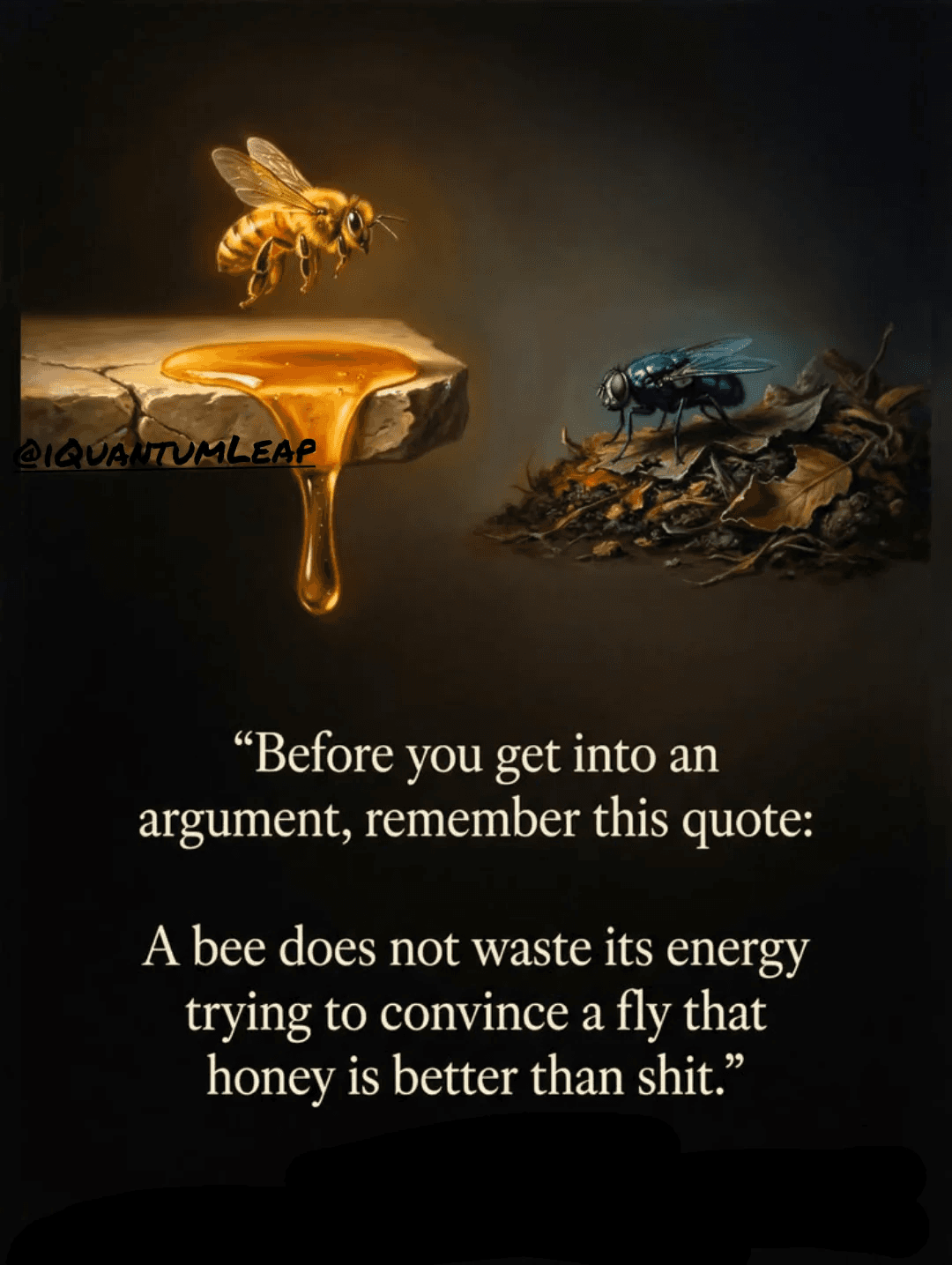
There’s a popular quote floating around the digital ether lately, usually plastered over a stock photo of a sunrise or a high-contrast image of a bee on a flower: "Bees do not waste their time explaining to flies that honey is better than shit."
At face value, it’s the ultimate "mind your business" mantra. It’s a call to stop arguing with people who "don't get it." It’s punchy, it’s arrogant, and it feels incredibly satisfying to post when someone disagrees with your take on a movie or a political candidate. But as I’ve been deep in the trenches writing my upcoming book, "They Lied To You" (dropping in 2 weeks, mark your calendars), I’ve realized that this quote actually serves as a perfect post-mortem for Western culture.
The problem isn’t that we are the bees and everyone else is the fly. The problem is that we’ve forgotten that the fly has a job to do, and more importantly, we’ve forgotten that honey is just bee vomit. We’ve reached a point in our cultural evolution where we no longer recognize the validity of different "niches." We have entered a state of terminal homogeneity where we believe that if something is "good," it must be good for everyone, and if someone doesn't like it, they are objectively wrong, stupid, or "a fly."
We are obsessed with explaining to the fly why the honey is better, not realizing that the fly literally cannot digest the honey. It eats what it eats because that is its role in the ecosystem. And the bee? The bee has become so insecure about its honey that it needs the fly’s validation to feel like the work was worth it. Somewhere along the way, we lost the plot. We started to think that people who are fundamentally different than us should think exactly like us, and we started to enter spaces and speak about things that were quite literally never made for us.
The "Glazing" Pandemic: Why We Fear Passion
If you spend five minutes on social media, you’ll see the word "Glazing." If you speak passionately about an artist, you’re glazing. If you break down why a specific film moved you to tears, you’re glazing. If you defend a friend’s work, you’re glazing. Our language is always a reflection of our culture, and right now, our language is telling us that authenticity is a myth.
The term "glazing" is a defensive mechanism born out of a profound cultural sickness. It is a reflection of a society that no longer believes people can genuinely enjoy anything enough to speak with sincerity. When you call someone a "glazer," what you’re really saying is: "I am so hollowed out by irony and cynicism that I cannot fathom a world where you actually love that thing. You must be performing. You must be seeking clout." We have weaponized the fear of being "corny" to the point where we’ve neutralized passion itself. Look at an artist like Logic. For years, he has been hammered by the "cool" corners of the internet. Why? Because he’s positive. Because he’s earnest. Because he’s "corny." In our current cultural climate, being "corny" is a greater sin than being a hateful person. We treat positivity like a defect because positivity requires the vulnerability of being "all in" on something.
Hating, on the other hand, is efficient. It is the path of least resistance.
If I say I hate a specific Drake album and you say you hate it too, we don't even have to agree on whywe hate it to feel like we’re on the same team. We just match the energy and double the hate. Hate requires no thinking; it only requires a target. But liking something? Truly liking something and building a "team" around that love is incredibly difficult. We might not agree on what we like about it. I might have feelings for a song that I can't quite put into words, and you might challenge my interpretation. Liking something requires a back-and-forth; it requires negotiation. It requires us to reveal who we are.
Because we are too scared to do that, we connect around who we are against.
The Illusion of Objectivity: Why Your 7/10 Doesn't Matter
I’ve reached a point where I can no longer consume "professional" criticism. Whether it’s the decimal-point pedantry of Pitchfork or the high-energy "light to decent" scores of Anthony Fantano, the core issue is the same: The number scale is a lie.
These reviewers operate on a presupposition of objective quality, but that objectivity is built on a foundation of personal bias and social conditioning. When a critic pans a project, they rarely start from a place of, "Who was this made for, and did it reach them?" Instead, they approach it from a place of, "Does this fit into the narrow window of what I have deemed 'intellectually stimulating' at this moment in time?"
Take the discourse surrounding Justin Bieber’s Coachella performance this year. By every measurable metric of "the people," it was a triumph. He broke records in the first week. The crowd was a sea of people experiencing genuine, unadulterated joy. Yet, the critical class rushed to their keyboards to call it "lazy" or "uninspired."
They saw a man who has been a global superstar since puberty performing with a relaxed confidence, and they called it a lack of effort. They were bees trying to tell the fans (who were happily consuming exactly what they came for) that their "honey" was actually "shit." But the fans weren't there for a high-concept, avant-garde piece of performance art. They were there for the hits. They were there for the "Bieber-ness" of it all.
The critic catches an attitude and says "this is bad" because they refuse to learn from the people the art was actually made for. They refuse to acknowledge that normal is an illusion. As the saying goes: "What is normal for the spider is chaos for the fly."
The Sociology of the "Me": Why We Can't Stop Arguing
Why do we do this? Why are we so desperate to force our perspectives onto others? Why are our cortisol levels spiked as we scroll through social media, ready to go to war over whether the "Drake era" is over?
To understand this, we have to look at how we build ourselves. We aren't born with an "ego"; we negotiate it with the world around us.
1. The Looking-Glass Self (Charles Horton Cooley)
The sociologist Charles Horton Cooley gave us a framework for this back in 1902, and it’s more relevant now in the age of the "Like" button than it ever was then. He argued:
"I am not what I think I am, and I am not what you think I am. I am what I think you think I am."
This is the Looking-Glass Self. We see ourselves through the reflection of others. When you post a take on the Drake vs. Kendrick "Not Like Us" era, you aren't just sharing an opinion. You are performing a version of yourself that you hope others will perceive as "knowledgeable," "authentic," or "on the right side of history."
If the "fly" (the person with the different perspective) doesn't agree with you, it doesn't just mean they have a different opinion—it means your mirror is broken. You feel an existential threat because your identity is built on their perceived judgment of you.
2. The "I" vs. the "Me" (George Herbert Mead)
George Herbert Mead took this further. He suggested the self has two parts: the "I" (the spontaneous, impulsive response) and the "Me" (the social self that cares about approval).
When you hear a catchy Drake song, your "I" might want to dance. It’s impulsive; it likes the beat. But your "Me"—the part of you that has internalized the attitudes of "correct" music Twitter—reminds you that the current narrative is that "the Drake era is over." So, you suppress the "I" and post a snarky comment about how he’s "washed."
The "Me" is constantly adjusting to social contexts. We are never "one thing" because we are constantly negotiating which audience we are performing for. We’ve become a culture of "Me's" with no "I's" left.
The Death of American Cultural Hegemony and the "Not Like Us" Tribe
This constant negotiation and our inability to accept "the other" is exactly why American culture is losing its grip on the world.
For decades, American culture was "dope" because it was confident. We created jazz, rock, hip-hop, and Hollywood films with an internal focus. We weren't asking the world if it was okay; we were just doing it, and the world followed because they loved the passion.
But lately, we’ve become the insecure bee. We see the UK rap scene or the rise of African and Latin music, and instead of celebrating the evolution, we get defensive. We bash any culture that is a derivative of ours or—worse—completely different. We’ve stopped being creators and started being gatekeepers of a gate that doesn't even exist anymore.
We enter spaces that were not made for us and demand they change to suit our sensibilities. We see this in the discourse between American and UK rap. Americans often dismiss the UK sound because it doesn't fit the "standard" cadence of Atlanta or New York. We don't stop to think: "Maybe this isn't for me. Maybe this is for a kid in South London who sees his reality in these bars."
The "Not Like Us" mantra is the ultimate expression of this. It’s a powerful rallying cry, but look closely at what it builds. It builds a tribe based entirely on exclusion.
"They are not like us."
"Do we agree on who 'us' is?"
"Nah... but we know who 'they' are."
If someone asks what the "us" actually stands for, the response is usually defensive: "Clearly you not with us if you have to ask." This works as long as there is an enemy to fight. But once the "Other" disappears—once Drake is off the charts or the UK rappers stop trying to break into the US—the tribe falls apart. We find out we only had our hate in common.
This is why the only groups that seem consistent in music, movies, and pop culture today are groups defined by what they are fighting against. It makes it easy to discuss. It’s easier to sit in a theater and talk about why a "woke" movie failed than it is to sit in a theater and talk about why a beautiful, quiet film made you feel less alone.
Life as a Stage: The Performed Self
Erving Goffman wrote a book called The Presentation of Self in Everyday Life, where he argued that life is essentially a theatrical performance. We are all actors on a stage, engaging in "Impression Management." We tweak our behavior to gain the approval of our specific audience. The "self" isn't a hidden truth inside us; it’s the cumulative effect of the performances we give.
The reason Western discourse is so toxic right now is that the stages have overlapped. In the past, you were one person at the pub, another at work, and another at home. Now, on the internet, all your audiences are watching at once. You are performing for your friends, your enemies, your boss, and a stranger in another hemisphere simultaneously.
This creates a high-pressure environment where we feel we must "correct" anyone who doesn't fit our script. If someone likes a movie you hate, they aren't just a person with a different taste; they are a "bad actor" on your stage.
The Reality Check:
Most of what exists in this world of over 8 billion people isn't for you. Your inability to recognize this is why your cortisol levels are spiked. You are fighting a war against the reality of human diversity. If Justin Bieber's show was "objectively" lazy, people wouldn't have shown up in droves. If Drake’s music was "objectively" bad, the numbers wouldn't keep climbing year over year.
We have replaced "I don't like this" with "This shouldn't exist." And in doing so, we’ve lost our humanity. We only give people their "flowers" after they are gone—because once someone is dead, they are no longer a threat to our "Me." They can no longer challenge our social standing with their inconvenient positivity. We give flowers to the dead because it’s a safe performance of empathy that requires zero actual engagement with the living person.
Getting Back to the Honey
We need to get away from number reviews and "glazing" accusations. We need to stop trying to "get people" on 15-second clips and instead go deep on what we love.
Passion is the only thing that actually translates across cultures. People love passion. They love seeing someone who is comfortable in their own heart with the choices they have made. When you are comfortable in your own skin, you don't feel the need to explain to the fly why the honey is better. You just eat your honey.
We’ve forgotten that taking the time to communicate our ideas—not to "win," but to share—is worth it. We’ve traded the difficult, beautiful work of connection for the cheap, efficient high of communal hating.
The Path Forward: Empathy over Cortisol
Until you can be comfortable with your own heart, you will never be able to accept others for theirs. If you find yourself scrolling through social media, feeling that familiar itch to "correct" someone’s joy, ask yourself: Am I being a bee, or am I just an insecure actor on a stage I didn't build?
The next time you see something online that makes your blood boil—a song you hate, a fashion trend you don't understand, a performance you find "lazy"—take a breath and say the four most powerful words in the English language:
"It's not for me."
That’s it. That’s the secret. You don't have to "explain to the fly." You don't have to bash the derivative. You don't have to manage your "Me" to fit the hive mind of the critics. You don't have to worry about "glazing" because you know your love is authentic.
We are all just organisms trying to find what nourishes us in a chaotic world. For some, it's honey. For some, it's shit. And for the spider, the whole thing is just a web anyway.
Let's stop trying to be the judges of a world we only see a fraction of. Let's get back to the passion. Let's get back to the soul. And most importantly, let's stop lying to ourselves about why we’re really arguing.
Featured Posts