>
>
The Capitalism of the Diss Track: A New Theory on the War for Drake’s Catalog and the Death of the Record Label
The Capitalism of the Diss Track: A New Theory on the War for Drake’s Catalog and the Death of the Record Label
Looked at through this lens, UMG didn't just want to contain Drake; they needed to contain him. He had to remain predictable, neutralized, and locked tightly into their distribution pipeline to guarantee the exact metrics required to fight off Bill Ackman.
Django Degree
The Capitalism of the Diss Track: A New Theory on the War for Drake’s Catalog and the Death of the Record Label
What if the most explosive cultural event of our generation wasn't actually a rap battle at all?
For the past two years, the dominant narrative surrounding the historic clash between Kendrick Lamar and Drake has been framed entirely around culture, lyricism, and authenticity. We watched two generational titans trade devastating records, the public picked a definitive victor, and the genre moved on. But if we take a step back and look at the timeline from a macro-financial perspective, especially in light of the massive ripple effects across the music industry, a much more chilling alternative theory begins to take shape.
What if we have been looking at the wrong map? What if the intense, coordinated cultural pressure brought down on music's biggest earner wasn't just an organic moment of artistic competition, but a highly sophisticated, multi-billion-dollar corporate containment strategy?
If what Drake alleges in his legal filings is even remotely close to the truth, then his current scorched-earth battle against Universal Music Group (UMG) isn't just a bitter contract dispute or a defense of his reputation. He is fighting a proxy war for the very future of musical sovereignty.
Consider this a thought experiment. Looked at through a new lens, the events of the last two years might just be the opening salvo of an existential war between the world’s most valuable independent-minded creator and a legacy industry trying desperately to protect its gatekeeping monopoly before the entire record label model collapses into obsolescence.
I. The Modern Utility: Why a Sovereign Catalog Threatens the Empire
To understand why a major label would potentially turn its machinery against its own top-performing asset, we first have to discard everything we think we know about how music catalogs are valued.
For nearly a century, the financial foundation of major record labels has been built on legacy acquisition. Labels owned the master recordings of the 1960s, 70s, and 80s, treating those classic catalogs like low-volatility corporate bonds. They used the predictable, steady revenue generated by those legacy titles to offset the high-risk, high-failure venture of scouting and developing new talent.
But the streaming economy has quietly inverted this entire equation, creating a fundamental shift that is rarely discussed in public:
[The Legacy Model] -> High-volume, low-margin catalog dependencies used to fund high-risk new artist development.
[The Modern Utility Model] -> A single, hyper-prolific streaming ecosystem commands a permanent percentage of global consumption pools.
In the modern streaming ecosystem, royalties are distributed via a pro-rata model—meaning all streaming revenue is pooled together, and artists are paid out based on their total percentage of global market share. Under this architecture, an elite, hyper-prolific catalog doesn't behave like old music waiting for a nostalgia cycle. It operates as a permanent digital utility. It taxes the entire streaming grid, day in and day out, commanding a massive, unyielding percentage of daily consumption metrics.
This leads us to a stunning financial theory: Drake’s modern streaming footprint is arguably worth more in active liquidity than the entire legacy catalogs of the 1960s, 70s, 80s, & combined.
When an individual creator commands that much market share, they cease to be an artist working inside an industry ecosystem. They become the ecosystem itself. And that is exactly where the structural threat to the major label system begins. If an asset of that magnitude achieves complete, unencumbered independence. Meaning the artist finishes their contract, retains their masters, and launches a decentralized, direct-to-consumer distribution infrastructure. The major label is instantly exposed as an incredibly expensive, obsolete middleman.
The theory suggests that a war for Drake’s catalog is not just a standard contract negotiation. It is a war to determine whether a single creator can achieve absolute escape velocity, breaking the foundational concept of the major record label forever.
II. The Flattening Hypothesis: How Corporate Structures Manage Volatile Assets
If we operate under the theory that a creator achieving complete independence is an existential risk to a multi-billion-dollar corporate entity, a logical question arises: How does a legacy power structure manage a volatile asset that has outgrown its ecosystem?
You cannot simply delete the asset, because your short-term quarterly earnings depend heavily on its revenue generation. Instead, a corporate entity might employ a strategy of brand compression or "flattening."
Think about the timing of the 2024 beef. Drake’s historic, massive joint-venture and distribution agreement with Republic Records and UMG was approaching a critical macro-window for restructuring, valuation adjustment, and renewal. When an artist reaches that level of leverage, their bargaining power is absolute. They can demand concessions that fundamentally disrupt the corporate profit model. Such as 100% master ownership, absolute operational autonomy, or a clean exit to launch an independent platform.
How do you suppress that leverage without destroying the underlying cash flow?
You allow, encourage, or actively accelerate a reputational flattener.
Looked at from a corporate perspective, you don't need to kill the artist’s commercial engine; you just need to damage their brand premium enough so that their independent valuation thins out at the negotiating table.
By creating an environment where your top earner is culturally isolated, defensively compromised, and stripped of his untouchable commercial premium, you effectively lower his leverage. If the public believes an artist is losing his grip on the cultural vanguard, that artist's ability to smoothly transition into a sovereign, industry-disintermediating entity is severely hindered. They are forced to stay inside the safety of the major distribution pipeline just to maintain their positioning. The cultural warfare we witnessed on the radio may have been an organic artistic dispute on the surface, but underneath, it perfectly served the structural balance-sheet needs of the corporation.
III. Kendrick Lamar as a Structural Proxy
If we follow this theory to its natural conclusion, it completely recontextualizes the roles of the players involved. Most importantly, it suggests that Kendrick Lamar was never the true target of Drake’s deep legal frustrations, nor was he the architect of the structural trap Drake believes he was walking into.
In this grand corporate strategy, Kendrick Lamar may have been the perfect, highly effective structural proxy.
This perspective is heavily supported by the unredacted legal petitions filed by Drake’s team under Frozen Moments, LLC in New York and Texas courts. When you look closely at those filings, a shocking detail emerges: Drake didn’t sue Kendrick Lamar for defamation. He aimed his legal offense directly at UMG, the exact corporate parent company that funds, distributes, and houses both artists.
The core of Drake’s legal claim is that UMG knowingly approved, packaged, and aggressively promoted a record ("Not Like Us") that leveled catastrophic, unproven criminal allegations against their own primary earner. Why would a company do that? Because from a short-term balance-sheet perspective, it was a flawless play. UMG generated historic, high-margin streaming revenue from Kendrick's release, while simultaneously using that exact same record to systematically erode Drake's untouchable premium at the bargaining table.
Furthermore, Drake's petitions alleged that UMG went as far as utilizing commercial resources, intentional payola networks, and streaming bots to artificially inflate the metrics and visibility of the diss track to control the public narrative. Kendrick Lamar delivered a brilliant, generation-defining artistic performance. But within the cold matrix of corporate finance, this theory suggests he was utilized as the mechanism through which the label suppressed the leverage of an artist who was on the verge of outgrowing the entire machine.
IV. The $64 Billion Macro Chess Match: Ackman vs. Bolloré
To understand why the leadership at UMG would feel compelled to execute such a high-stakes containment strategy, we have to look entirely outside of hip-hop and focus on the intense corporate warfare happening in the boardroom. The music industry is no longer governed by music executives; it is dictated by European industrial power and aggressive Wall Street activism.
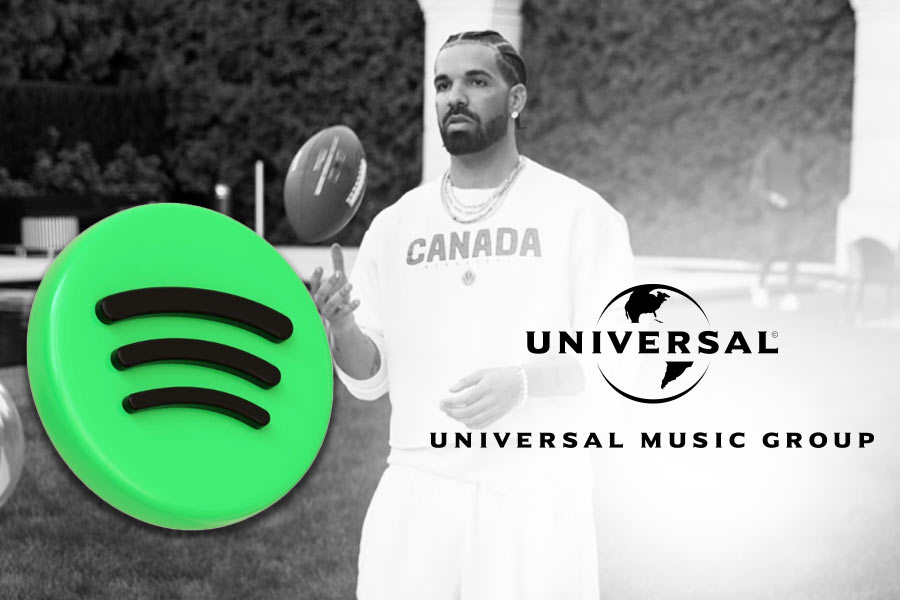
Billionaire hedge fund manager Bill Ackman, via Pershing Square Capital Management, shocked the financial world by launching an unsolicited, non-binding $64 billion (€55.75 billion) takeover bid to buy out UMG, value the company at roughly €30.40 per share, take it completely private, and pull it off the Euronext Amsterdam stock exchange. Ackman’s thesis is built on a simple premise: UMG’s public stock price lags far behind its actual intrinsic worth, and under private Wall Street management, its true monetization potential can be unlocked.
The defensive response from UMG’s largest single shareholder, the ultra-wealthy French Bolloré family, led by billionaire patriarch Vincent Bolloré and Vivendi Chairman Cyrille Bolloré, was immediate and fierce. Cyrille Bolloré publicly urged shareholders to reject the bid, stating flatly that "the price is not there at all." The board, led by CEO Sir Lucian Grainge and Chair Sherry Lansing, backed the Bollorés and unanimously rejected Ackman’s $64 billion offer, claiming it materially undervalued the company.
To appease nervous institutional investors and prove they didn't need a Wall Street buyout to survive, UMG immediately deployed an aggressive financial defense:
They launched a massive €500 million share buyback program to artificially fortify stock value.
They announced plans to monetize half of their multi-billion-dollar equity stake in Spotify for immediate liquidity.
They promised enhanced, aggressive financial disclosures to prove their standalone value to the market.
When a corporation is defending a $64 billion valuation against a hostile Wall Street takeover, absolute predictability is required. Your financial forecasting models cannot have a single variable out of place. If your biggest artist, the guy who single-handedly commands a massive chunk of your global streaming market share, is preparing to walk out the door and take his entire compounding catalog with him, your corporate defense strategy collapses.
Looked at through this lens, UMG didn't just want to contain Drake; they needed to contain him. He had to remain predictable, neutralized, and locked tightly into their distribution pipeline to guarantee the exact metrics required to fight off Bill Ackman.
V. The Empire’s Moats: The Systematic Suppression of Artist Autonomy
This theory of a corporate containment strategy against Drake perfectly aligns with how major music groups have been quietly building legal and technological walls across the entire industry. The goal is simple: ensure that no creator, legacy or modern, can ever truly own their destiny.
On the artistic front, major labels have pivoted sharply away from human curation and high-risk hip-hop A&R. Warner Music Group (WMG) terminated roughly 10% of its workforce, deliberately gutting established hip-hop and youth media spaces like HipHopDX and Uproxx in favor of cost-saving algorithms. UMG implemented headcount reductions under their "Building a Better UMG" program, slicing boutique divisions like Mercury Studios and redirecting their capital into massive licensing deals with generative AI companies like Udio and Stability AI.
Simultaneously, the major labels have been using the federal court system to permanently slam the door on creators trying to reclaim their life's work. Look at the devastating ruling achieved by UMG against hip-hop pioneers Salt-N-Pepa. The group attempted to utilize Section 203 of the US Copyright Act (Termination Rights), which technically allows creators to take back ownership of their copyrighted works after 35 years.
UMG’s legal team fought them ruthlessly, arguing that because the original 1986 contract used future-tense language stating the label “shall be the exclusive and sole owner,” there was never a technical "transfer" of ownership from the artist to reverse. The court agreed with UMG, leaning on the "work-made-for-hire" doctrine and effectively establishing a terrifying precedent: the label is the legal author from day one, and the artist can never leave with their masters.
Combined with funk legend George Clinton’s ongoing battle against UMG for over $1.1 million in systematically withheld royalties, a clear pattern emerges. The legacy label system relies on opaque accounting architectures and hyper-aggressive litigation to ensure that whether you are an 80s pioneer or a modern titan, you can never cleanly track your money or achieve true legal autonomy.
VI. The $4 Billion Endgame: Drake’s Absolute Predicament for UMG
The problem with a corporate containment theory is that it relies on the asset cooperating with its own confinement. But true market dominance cannot be bottled up by a board of directors, and the final numbers have completely shattered the paradigm. As Drake’s ICEMAN debuts atop the Billboard 200 albums chart (dated May 30, 2026), it has not only scored the biggest streaming week for any album in 2026, but it has officially landed as one of the top 10 largest streaming weeks in the history of music.
According to data from Luminate, ICEMAN arrived with a staggering 462.2 million on-demand official audio and video streams across the album’s 18 tracks in the United States alone during its tracking week ending May 21. This sum places ICEMAN at No. 10 on the all-time list of the biggest streaming weeks for albums—a list where half of the top 10 spots are now held exclusively by Drake releases. All ten of those record-breaking historical weeks are debut weeks. Furthermore, Drake now commands the top five largest streaming weeks ever among R&B/hip-hop albums, with ICEMAN’s start coming in at fifth.
This historic moment marks Drake’s 15th No. 1 album on the Billboard 200, tying him with Taylor Swift for the most No. 1s among soloists in music history. He has officially surpassed Jay-Z for the most No. 1s among solo men and R&B/hip-hop acts, leaving only The Beatles ahead of him with 19 historic leaders.
What do these historic milestones mean when we bring them back to the corporate negotiation table? It means that if Drake has officially fulfilled and exited his distribution contract with this 2026 triple-album trilogy (ICEMAN, Habibti, and Maid of Honour), his stock is sitting at an absolute, uncontested all-time high.
In this exact moment of negotiating his next move, Drake is functionally larger at the table than almost all other hip-hop artists combined. History always plays a massive role in standard corporate evaluations, but Drake has proven that he isn't just an individual artist on a roster, he is an autonomous financial entity.
Again, because streaming platforms distribute global revenue based on pro-rata market-share pools, an asset that commands this type of permanent, massive percentage of daily global consumption effectively places an unavoidable tax on the entire digital music ecosystem. Drake’s standalone market value is no longer just a metric within hip-hop; his value has grown larger than the genre itself.
This leaves Universal Music Group in a devastating, unprecedented predicament. Modern music now sits on corporate balance sheets as an alternative asset class that Wall Street speculators can bid on. Yet, an asset of Drake’s specific scale and streaming gravity has never been sold or detached from a major label system before.
If Drake walks away from UMG and signs a fully independent catalog or infrastructure partnership valued at $2 billion, it instantly establishes a brand-new, terrifying baseline value for copyrights across the entire industry. It sets the concrete asset value for what major music groups hold, while simultaneously forcing a massive, permanent revaluation loss on UMG’s books. The continuous, multi-billion-stream cash flow they relied on to stabilize their quarterly earnings and fight off hostile takeovers from activist investors like Bill Ackman will be gone. Forever.
If this theory holds true, the corporate war masked as a rap beef didn't save the old guard, it merely delayed the inevitable. Universal Music Group and the very concept of the traditional record label will never be the same. The corporate masters wanted to control the script, but they forgot a fundamental law of the digital age: you can’t leverage a god when he owns the matrix.
Featured Posts